Her Favourite Daughter
Author: Shana Granderson
Genre(s): Romance | Historical
Total pages: 85
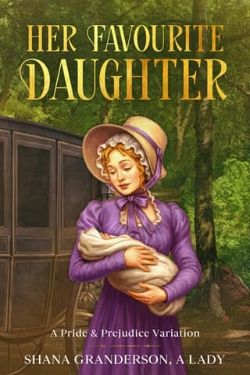
This is a ‘Lizzy is not a Bennet’ tale.
The Duke and Duchess of Leeds have been married for more than ten years and they have never been blessed with a live son or daughter. To a certain point all they have experienced are miscarriages.
A male is not needed as the patents are written in such a way that the dukedom will continue with a male or female child. If Lady Amelia Osborne, the Duchess of Leeds, gives birth to a child a distant cousin of Lord Francis Osborne, the Duke of Leeds, will be replaced as the heir presumptive by the newly born heir apparent. That distant cousin is one Sir Lewis de Bourgh.
Lady Amelia is the daughter of Lord Robert Darcy, the Earl of Holderness. The father of the Darcy we know, also named Robert after the cousins’ shared great-grandfather, has no interest in a title and is quite content that his distant cousin is the holder of the title. Mr Robert Darcy’s plans are overthrown when his cousin dies in 1781 with no male issue. The patents of the earldom do not allow the title to flow through the female line.
Robert Darcy of Pemberley becomes the Earl of Holderness just before he married Lady Anne Fitzwilliam and when their son is born, he becomes Viscount Conyers. Ladies Elaine (the Countess of Matlock) and Anne are the best friends of Lady Amelia and their husbands are all very good friends as well.
Lady Catherine Fitzwilliam vociferously objects to her sister marrying before her and to an untitled man. She is ignored by all. When she learns that Mr Darcy is the new Earl of Holderness, she tries to offer herself as his wife. The new earl is not interested. She marries a knight, Sir Lewis de Bourgh, because he is the heir presumptive to a duke and she cannot wait to have a higher rank than her younger sister.
In March of 1791 Lady Amelia gives birth to Lady Bethany Anne Elaine Osborne at the duke’s main estate in south-west Yorkshire. She has the same raven coloured hair like her mother and the Osborne birthmark in the same place as her father’s. By five months of age her eyes turn emerald-green like her mother’s.
Lady Catherine is most displeased that not only did the duchess birth a child, but the whelp is healthy. She and her husband make plans…
At the same time, Fanny and Thomas Bennet live in the town of Grantham in Yorkshire. They are deeply in love and respect one another. Fanny suffers from a stillbirth after her first pregnancy and then Jane is born after they arrive in Grantham.
After Jane is born, Fanny suffers a miscarriage or two before she carries a second child to term, James, named after his grandfather.
After distressing news which necessitates Fanny and Thomas removing their family to Longbourn, they head south. At a stop in Lincolnshire, Fanny goes for a walk in a nearby forest. There she hears the crying of a baby. She finds a carriage, with a dead man slumped against a tree. She discovers a distressing part of a note in his pocket.
As she still feeds her son, she is able to feed the beautiful girl babe she finds in the carriage. Based on the note and assumptions flowing from it, Fanny decides the girl is now her daughter. After seeing the partial note, Thomas agrees and they continue the journey without a word to anyone about the found baby.
Over the years, as there was never a body found, Lady Amelia refuses to believe her Bethie is dead. We see how she is found, who finds her, and the way it effects the Bennets and their family who love their Lizzy, as they named her, no less than any child born of Fanny’s body. The Bingleys and Wickham feature in this one, as do some of the characters I have introduced over the course of my books.
Share this Book