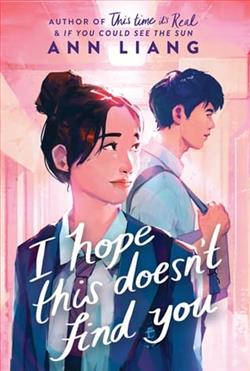
I Hope This Doesn't Find You by Ann Liang is a mesmerizing and poignantly crafted novel that navigates the intricate terrains of love, memory, and identity through a compelling speculative fiction lens. Liang's narrative prowess and her keen sense for emotional depth make this book a fascinating journey through a world where technology intersects with the most human elements of existence.
The novel introduces us to Thea, a young woman grappling with the loss of her lover, Luca, who vanished mysteriously. Set against the backdrop of a near-future world, Thea discovers a revolutionary technology that allows her to send messages to her past self. Ostensibly designed to prevent tragedies or unfavorable outcomes, the technology sparks Thea's hope of altering their shared past and perhaps, changing the outcome of their future. The story unfolds through a series of these messages, each a poignant echo of regret, longing, and introspection.
Liang’s exploration of memory as a malleable and unreliable narrator is riveting. As Thea sends these messages back in time, the readers are pulled into a vortex of "what if" scenarios, each more heart-rending than the last. The storyline smartly dodges the typical tropes of time-travel fiction, focusing instead on the emotional and psychological impacts of Thea's attempts to rewrite history. This mechanism serves as a double-edged sword, offering both solace and torment, as Thea increasingly questions the ethics and consequences of her actions.
The character development in I Hope This Doesn't Find You is subtly powerful. Thea’s evolution from a grief-stricken individual to a determined, albeit morally conflicted protagonist is beautifully portrayed. Liang uses a first-person narrative to delve deep into Thea's psyche, pulling the readers into her internal conflicts and ethical dilemmas. This intimate perspective makes Thea's journey not just a personal battle but a universal exploration of human fragility and resilience.
Ann Liang’s prose is another element where the novel truly shines. Her writing is lyrical yet precise, with beautifully crafted sentences that convey the vast landscapes of emotion contained within Thea’s story. The dialogues are crisp and impactful, carrying the weight of the novel’s thematic concerns without becoming preachy. Liang’s ability to paint vivid emotional and physical landscapes with her words adds a layer of richness to the narrative, making the settings almost palpable. The near-future world is sketched with enough detail to be believable but not so much that it overwhelms the personal story at the heart of the book.
The thematic depth of the novel is significant, touching on issues of mental health, the ethics of technological advancement, and the timeless human quest for control over personal fate. Each theme is intricately woven into the fabric of the storyline, providing much food for thought. The technology, while a key plot device, also metaphorically reflects the human desire to fix the unfixable, to reach back into the past for answers to the present. This mirror to human nature invites readers to question their own relationships with the past, their memories, and their choices.
However, the plot does at times become weighed down by its own complexity. The intricacies of how messages affect the past and the consequent changes in the timeline can be a bit convoluted. While Liang generally handles these transitions well, there are moments where the narrative could have benefited from clearer demarcations between shifts in time and perspective, especially in the latter parts of the book.
What truly sets I Hope This Doesn't Find You apart is its ending. Without venturing into spoilers, it’s sufficient to say that Liang handles the resolution of her complex plot with finesse, leaving the reader with a mix of melancholy and contemplation. It’s a testament to her storytelling ability that the ending feels both surprising and inevitable, a rare feat in novels dealing with themes of fate and free will.
Overall, I Hope This Doesn't Find You by Ann Liang is a thought-provoking, emotionally charged novel that seamlessly melds elements of speculative fiction with deep, existential questions. It is a vivid, well-crafted reminder of the power of memory, the pain of loss, and the unyielding human desire to seek redemption and meaning—even through the impossible. For fans of speculative fiction with a heavy dose of human emotion and ethical quandaries, this novel is a compelling read.