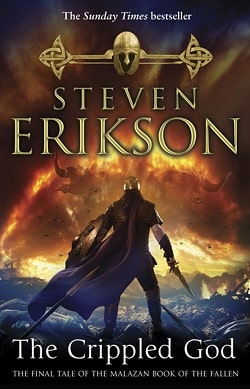
Steven Erikson's The Crippled God, the tenth and final installment in the Malazan Book of the Fallen series, is a masterful conclusion to one of the most ambitious and complex fantasy series ever written. As the series reaches its climax, Erikson weaves together numerous storylines, characters, and themes to deliver a narrative that is both epic in scope and deeply personal in its exploration of human nature and the cost of war.
At the heart of The Crippled God is Adjunct Tavore Paran, a character who has been a central figure throughout the series. Tavore is a fascinating protagonist, not because of any magical prowess or charismatic leadership, but because of her unwavering determination and moral conviction. She is a woman who, despite being deemed plain and unremarkable, dares to challenge the gods themselves. Her journey is one of resilience and sacrifice, and Erikson does a remarkable job of portraying her as a leader who inspires loyalty not through grand gestures, but through her steadfast commitment to her cause.
The themes of loyalty, sacrifice, and the human cost of war are prevalent throughout the novel. Erikson does not shy away from depicting the brutal realities of conflict, and the Bonehunters' march for Kolanse is fraught with tension and uncertainty. The army is on the brink of mutiny, and Tavore's leadership is constantly tested. Yet, it is in these moments of crisis that the true nature of the characters is revealed. Erikson's ability to delve into the psyche of his characters, exploring their fears, doubts, and motivations, is one of the novel's greatest strengths.
One of the most compelling aspects of The Crippled God is its exploration of the concept of power and its corrupting influence. The Forkrul Assail, as the final arbiters of humanity, represent an alien power that seeks to cleanse the world through annihilation. Their belief in their own righteousness and their willingness to betray their allies for their cause is a chilling reminder of the dangers of absolute power. Erikson's portrayal of the Forkrul Assail is both terrifying and thought-provoking, forcing readers to question the nature of justice and the cost of pursuing it at any cost.
In contrast, the subplot involving the Elder Gods—Kilmandaros, Errastas, and Sechul Lath—adds another layer of complexity to the narrative. Their efforts to free Korabas, the Otataral Dragon, from her eternal prison, highlight the destructive potential of unchecked power. The impending arrival of the Eleint, the dragons, serves as a metaphor for the chaos and destruction that can result from the pursuit of power without regard for its consequences.
Erikson's world-building is nothing short of extraordinary. The realm of Kurald Galain, the city of Kharkanas, and the Gates of Starvald Demelain are vividly realized, each with its own unique history and mythology. The author's attention to detail and his ability to create a fully immersive world is a testament to his skill as a storyteller. The novel's setting is not just a backdrop for the action, but an integral part of the narrative, influencing the characters and their decisions.
In terms of character development, Erikson excels at creating complex, multi-dimensional characters who are flawed yet relatable. Yedan Derryg, commanding the Watch on the First Shore, is a prime example of this. His determination to defend an empty city and a queen with no subjects is both tragic and heroic, and his story arc is one of the most poignant in the novel. Erikson's ability to create characters who are both larger-than-life and deeply human is one of the reasons why the Malazan Book of the Fallen series resonates with readers.
Comparatively, Erikson's work can be likened to that of George R.R. Martin's A Song of Ice and Fire series, particularly in its exploration of power dynamics and the moral ambiguity of its characters. However, Erikson's narrative is more expansive, with a greater emphasis on philosophical themes and the metaphysical aspects of his world. While Martin's series is grounded in political intrigue, Erikson's work delves into the existential, questioning the nature of humanity and the universe itself.
The overall impact of The Crippled God is profound. It is a fitting conclusion to a series that has consistently challenged the conventions of the fantasy genre. Erikson's ability to balance intricate plotlines with deep philosophical questions is a testament to his skill as a writer. The novel is not just a story of gods and magic, but a meditation on the human condition, exploring themes of sacrifice, redemption, and the enduring power of hope.
In conclusion, The Crippled God is a triumph of storytelling, a novel that will leave readers both satisfied and contemplative. It is a fitting end to a series that has pushed the boundaries of fantasy literature, and it cements Steven Erikson's place as one of the genre's most innovative and thought-provoking authors. For those who have journeyed through the Malazan Book of the Fallen, this final installment is a must-read, offering a powerful and unforgettable conclusion to an epic saga.